
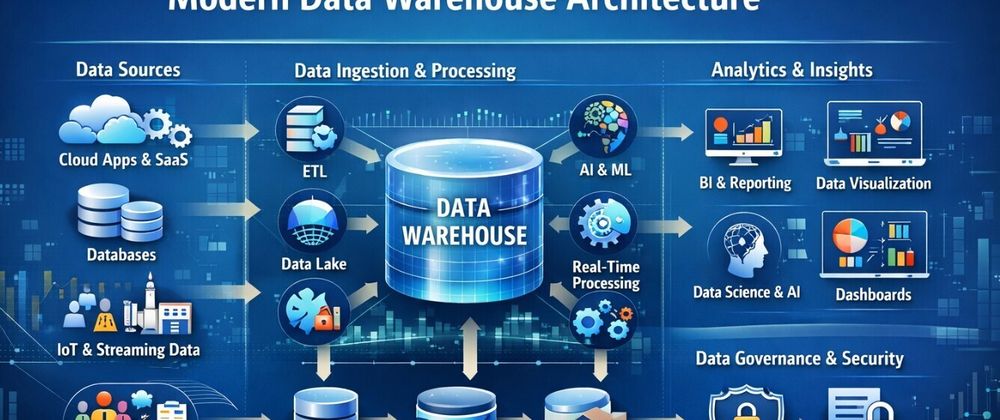

A world where all the data your organization gathers flows effortlessly, is analyzed in real time, and makes smarter decisions every second. This is the truth with a modern-day data warehouse. It functions as an engine of power that keeps business intelligence, analytics, and insights flowing. This is the age of data, and companies are no longer supposed to store the data but bring it to life instantly. Making this transformation available to data science professionals allows them to have quicker analytics, real-time results, and proactive intelligence.
This guide simplifies and interestingly breaks down modern data warehouse architecture. We describe the most essential terms, structure, and its necessity without using complicated jargon. Let’s begin.
What Is Modern Data Warehouse Architecture?
Modern data warehouse architecture is the structured design that determines the way that the data enters a centralized system, how it is stored, processed, and subsequently made available to analytics and reporting. Modern warehouses deal with real-time and past data easily, unlike traditional designs. This architecture enables businesses to scale, adapt, and accommodate sophisticated analytics like AI and machine learning.
Simply put, consider this architecture as a plan for your data infrastructure in your organization. It ensures that:
● Information from various systems enters smoothly.
● Storage is optimized to query fast.
● Information is provided in real time.
Why is This Architecture Vital?
An effectively designed data warehouse has an influence on all data processes within your business. It is not only intended for data storage. It ensures that:
● Information is valid and stable.
● Insights are delivered fast
● Making decisions is enhanced.
● Without redesign, future data requirements can be supported.
As technologies are developing at an impressive pace, modern architecture is a strategic necessity, rather than a luxury.
The modern warehouses can address some of the most frequent data problems, such as:
● Isolated systems that are not conversational.
● Sluggish analytics and sluggish reports.
● Formats problem leads to data quality problems.
Core Principles of a Modern Data Warehouse
The contemporary architecture is constructed on the basis of several concepts. Such principles guarantee that your warehouse is reliable and flexible:
Subject-Oriented
Your data is modeled on major business themes - such as sales, customers, and operations - rather than systems where it began.
Integrated
Information from various sources is integrated into one. This gets rid of discrepancies such as the different names of regions or irregular formatting.
Time-Variant
The past data is recorded in a format that allows trend analysis across time. This plays a very essential role in prediction and strategic planning.
Non-Volatile
When information is put into the warehouse, it is not modified or deleted. This provides reliable analytics.
Modern Data Warehouse Layers
In order to comprehend modern architecture, we have to look into its structural layers. Each has a distinct part in the data journey:
1.Source Layer
This layer gathers raw information from various sources. These sources include:
● Operational systems
● CRM and ERP platforms
● Applications, files, logs, and external applications.
Every source can be in a different format or structure; thus, this layer is the place where other data is initially collected.
2.Staging Layer
In this case, information waits temporarily, then it is processed. This step makes it possible to extract without logic or transformations. Information in this sphere is still not prepared to be analyzed.
3.Warehouse Layer
This is where the data warehouse is stored. Here, the data becomes:
● Standardized
● Time-stamped
● Organized for analytics
The structuring information analysts and decision-makers depend on this layer.
4.Consumption Layer
Lastly, this layer provides insights. It supports:
● Reports and dashboards
● Self-service analytics
● Queries by users and tools
Data at this stage makes sense in business decisions.
How Data Moves Through a Modern Data Warehouse?
To understand the architecture, it is essential to understand data ingestion and transformation:
● Batch Processing
The information is loaded in groups that are scheduled. The approach is dependable, but it is not optimal to deliver real-time insights.
●Streaming
The data is consumed on an ongoing basis. This supports current analytics.
● Change Data Capture (CDC)
In this case, only the changed data are captured and processed. This increases efficiency.
● Data Sharing
There are cloud systems that facilitate the sharing of data without copying. This maintains information active and alive between teams.
Key Components of Modern Architecture
1.Data lakehouse architecture
The data lakehouse is the unified system of data storage and processing of all types of data. It combines the flexibility of the data lake with the abilities of the conventional data warehouses in managing data. The data lakehouse can handle both structured and unstructured data, supporting any SQL analytics to machine learning workloads, and its features do not compromise data quality or performance.
2.Data integration tools
Data integration tools support two major data management methods, which are direct integration and data virtualization. Direct integration tools access data into the central database and transform it into a common format to analyze it with methods including ETL (Extract, Transform, Load), ELT (Extract, Load, Transform), and real-time and bulk-load processing. Data virtualization offers an interface to enquire data at the point of location by means of federation, providing an aggregated view across distant data areas without relocating data. These techniques can be used together with the help of automation, orchestration, and data quality and enrichment.
3.Metadata
Metadata is information regarding information, and it is applied in the management and government of data. Metadata provides data and history regarding the information, such as sources, transformation, structure, relationships, and utilization. Technical metadata defines what sets of data are known as schemas, data types, and lineage, and business metadata is used to define those sets of data in nontechnical terms.
4.Data access tools
Access data tools can be used by the user to query, analyze, and visualize the data stored in the data warehouse and bridge the gap between the raw data and the decision makers. The tools used to access data are reporting software, BI platforms, OLAP tools, data mining tools, application development tools, and APIs that allow nontechnical and technical users access to data.
5.Embedded AI and ML capabilities
The modern data warehouses have also been characterized with inbuilt AI and ML capabilities that enable automatic data processing, pattern recognition, anomaly detection, and predictive analytics. This is all incorporated into the warehouse setting and, therefore, does not require an autonomous AI/ML program.
6.Interactive dashboards
Visual analytics dashboards provide real-time access to the insights of data in the form of interactive graphs, charts, and reports. Both nontechnical and technical users use the self-service interfaces to explore data, create visualizations, and extract insights without the need to write tedious queries.
7.Governance framework
A comprehensive governance system manages access control data, security rules, rules and regulations, and data quality standards. It includes data lineage tracking tools, audit classification tools, privacy protection tools, and regulation compliance management tools that manage the whole data warehouse infrastructure.
Best Practices for Modern Warehouse Success
To get the full advantage of modern architecture, you should:
● Prefer scalable cloud-based services.
● Make sure of good data management.
● Automated data quality tools.
● Enhance self-service analytics.
● Align processes with business objectives.
The practices ensure that your warehouse is responsive and efficient.
Future Trends in Data Warehouse Architecture
The data environment is changing. Modern architectures will keep on developing in such aspects as:
● Real-time analytics
● AI-driven automation
● Multi-cloud and hybrid clouds.
● More robust tool integrations.
These trends make sure that data warehouses are at the center of analytics and innovation.
Conclusion
Intelligent data systems rely on modern data warehouse architecture. It scales, prepares, and makes data available. With the increasing volumes of data, companies are left to rely on good architectural design to remain competitive. You get to know the layers, components, and best practices, which place your organization in a position to make smarter decisions and to succeed in the long term.
Regardless of whether you are a beginner or one of the data science professionals venturing into more profound analytics, learning this architecture will transform the way you use data.




Top comments (0)