
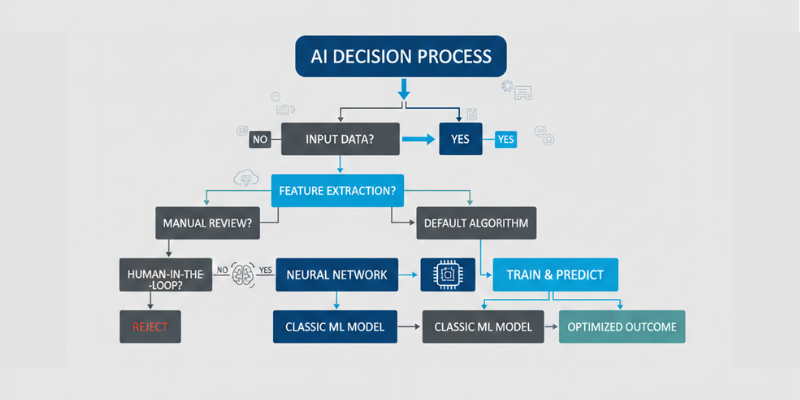

Decision trees represent one of the simplest methods to grasp how machines arrive at decisions. They work by breaking a problem into smaller questions and answering them step by step. Each answer leads to another question until a final decision is reached. This structure makes decision trees very useful for beginners who want to learn the basics of machine learning. Many students start their learning journey by enrolling in an Artificial Intelligence Course in Bangalore at FITA Academy to gain clarity on concepts like decision trees through guided practice and real-world examples.
What is a Decision Tree
A decision tree is a representation that resembles a flowchart. It starts with a single question at the top and branches out based on possible answers. Each branch represents a choice, and each final point represents an outcome. This approach mimics how humans think when solving problems. Because of this, decision trees are easy to interpret and explain even to people without a technical background.
Key Components of a Decision Tree
Decision trees are made up of three main components. The root node is the starting point where the first decision is made. Internal nodes represent conditions or questions based on input data. The leaf nodes indicate the ultimate decision or forecast. Each path from the root to a leaf shows how a conclusion is reached. Learning how these components work together helps learners build confidence to move beyond basics and explore advanced machine learning models by joining an Artificial Intelligence Course in Hyderabad that strengthens foundational knowledge through structured learning.
How Decision Trees Make Decisions
Decision trees work by selecting the best question at each step. The model checks different conditions and chooses the one that best splits the data into clear groups. This process continues until a stopping point is reached. The goal is to reduce confusion and increase accuracy with every split. This step by step logic helps machines classify data or make predictions in a simple and transparent way.
Types of Problems Solved by Decision Trees
Decision trees are primarily utilized for problems related to classification and regression. In classification, the model predicts a category, such as yes or no. In regression, it predicts a numerical value, such as price or score. Their flexibility makes them suitable for many real world applications, including customer behavior analysis and risk assessment. Learners interested in practical applications can take the next step by taking an AI Course in Ahmedabad to understand how decision trees connect with larger Artificial Intelligence systems through hands-on learning.
Advantages of Using Decision Trees
One major advantage of decision trees is their simplicity. They are easy to visualize and explain. They also require minimal data preparation since they can handle both numerical and categorical data. Decision trees can capture non linear relationships without complex calculations. These benefits make them a popular starting point for students and professionals who are new to Artificial Intelligence.
Limitations of Decision Trees
Despite their simplicity, decision trees have limitations. They can become too complex if allowed to grow without control. This could result in overfitting, in which the model demonstrates good performance on the training data but struggles with new data. Additionally, decision trees may be affected by minor variations in the data. Understanding these limitations helps learners choose the right model for the right problem.
Decision Trees in Everyday Applications
Decision trees are used in many everyday applications. Banks use them to approve loans. Online platforms use them for recommendation systems. Healthcare systems use them for diagnosis support. Their ability to provide clear reasoning makes them valuable in areas where transparency is important. Learning how decision trees are applied in real scenarios prepares learners for advanced AI concepts.
Decision trees offer a simple and intuitive way to understand how machines make decisions. Their logical structure and easy interpretation make them ideal for beginners in Artificial Intelligence. While they have limitations, they remain a powerful learning tool and a foundation for more advanced models. Those looking to build strong AI fundamentals can consider enrolling in AI Courses in Gurgaon to gain structured knowledge and hands on exposure that builds confidence beyond basics.
Also check: Understanding Context and Memory in AI Models




Top comments (0)