

Market Overview:
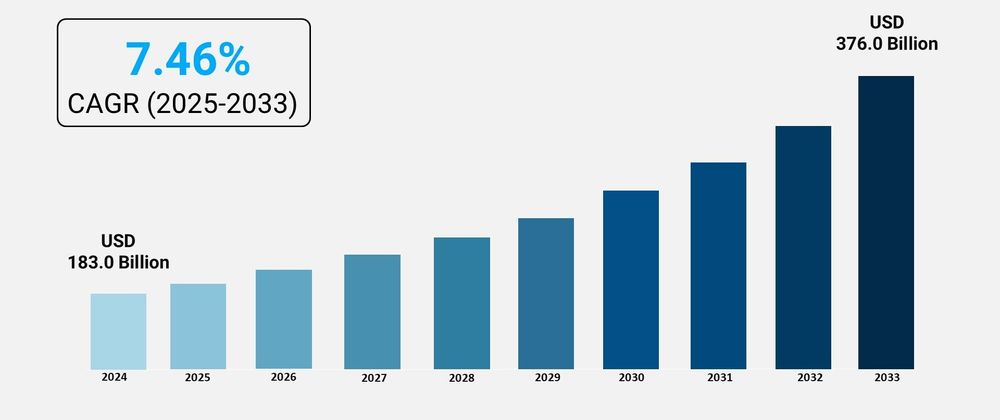
The aquafeed market is experiencing rapid growth, driven by surging global demand for high-quality seafood, government modernization and infrastructure initiatives, and corporate research and strategic industry consolidation. According to IMARC Group's latest research publication, "Aquafeed Market: Global Industry Trends, Share, Size, Growth, Opportunity and Forecast 2025-2033", The global aquafeed market size reached USD 183.0 Billion in 2024. Looking forward, IMARC Group expects the market to reach USD 376.0 Billion by 2033, exhibiting a growth rate (CAGR) of 7.46% during 2025-2033.
This detailed analysis primarily encompasses industry size, business trends, market share, key growth factors, and regional forecasts. The report offers a comprehensive overview and integrates research findings, market assessments, and data from different sources. It also includes pivotal market dynamics like drivers and challenges, while also highlighting growth opportunities, financial insights, technological improvements, emerging trends, and innovations. Besides this, the report provides regional market evaluation, along with a competitive landscape analysis.
Download a sample PDF of this report: https://www.imarcgroup.com/aquafeed-market/requestsample
Our report includes:
- Market Dynamics
- Market Trends and Market Outlook
- Competitive Analysis
- Industry Segmentation
- Strategic Recommendations
Growth Factors in the Aquafeed Market
- Surging Global Demand for High-Quality Seafood
The rapid expansion of the global population and a shifting consumer preference toward lean protein sources are primary catalysts for the aquafeed industry. As wild fish stocks face significant depletion from overfishing, aquaculture has become the essential bridge to meet nutritional needs, now accounting for nearly 50% of the world’s seafood supply. In 2024, global seafood production was estimated at 191 million tons, with approximately 16.7 million tons of that volume specifically directed toward feed use. This rising consumption necessitates high-performance, nutritionally balanced feeds to ensure faster growth cycles and better meat quality. Consequently, the global aquafeed market reached a valuation of roughly USD 71.28 billion by the start of 2025. This demand is further intensified by the growth of organized retail and e-commerce platforms, which have made premium seafood more accessible to urban populations, compelling farmers to adopt specialized feeds that enhance the taste and texture of high-value species like salmon and shrimp.
- Government Modernization and Infrastructure Initiatives
Strategic government interventions across major producing nations are significantly lowering barriers to entry and incentivizing the use of formulated feeds. In India, for instance, the Pradhan Mantri Matsya Sampada Yojana (PMMSY) allocated approximately USD 720 million in July 2025 for fisheries development, with 40% of these funds specifically dedicated to feed-related infrastructure. Additionally, regulatory reforms in September 2025 reduced the GST on fish oils and extracts from 12% to 5%, directly lowering input costs for manufacturers. Beyond financial aid, governments are establishing digital ecosystems, such as India’s 5th National Marine Fisheries Census 2025, which utilizes advanced mobile applications for real-time data collection. These initiatives provide farmers with better access to institutional credit and technical training, facilitating a transition from traditional, low-efficiency feeding methods to high-protein, scientifically formulated commercial feeds that optimize yield and ensure biosecurity across the global aquaculture value chain.
- Corporate Research and Strategic Industry Consolidation
Major industry players are driving growth through intensive research and development (R&D) and aggressive expansion strategies aimed at achieving economies of scale. In mid-2025, ADM established a state-of-the-art R&D facility in Switzerland focused on the aquatic microbiome, while DSM-firmenich opened a new feed additive plant in India to support the "Make in India" initiative. This period also saw significant consolidation, highlighted by IFB Agro Industries acquiring Cargill India’s shrimp and freshwater fish feed business in June 2025. These activities focus on developing functional feeds—products enriched with probiotics, enzymes, and immune boosters—that reduce the Feed Conversion Ratio (FCR) and enhance disease resistance. By investing over USD 1 billion collectively, top-tier firms like Mitsui & Co. and Skretting are not only expanding their manufacturing footprints but also pioneering "Smart Nutrition" solutions that combine advanced formulation science with commercial scalability to meet region-specific farming requirements.
Key Trends in the Aquafeed Market
- Integration of Deep Tech and Precision Feeding
The adoption of "Deep Tech" is revolutionizing how aquafarms manage their daily operations, shifting from manual labor to AI-driven precision systems. In 2025, it is estimated that up to 70% of new aquaculture facilities are integrating automation to monitor water quality parameters such as pH, dissolved oxygen, and salinity in real-time. A prominent example is the Indonesian company eFishery, which utilizes an IoT-based platform that allows farmers to track feeding schedules via automated feeders. These systems use computer vision algorithms and underwater cameras to assess fish size and detect active feeding behavior. By adjusting feed distribution based on actual appetite and biomass, these technologies can reduce feed waste and nutrient runoff by up to 15%. This trend toward "Smart Aquafarms" ensures that nutrients are delivered with surgical precision, drastically improving the profitability of farms while minimizing the environmental impact of excess nitrogen in the water.
- Commercialization of Alternative Protein Sources
To reduce the industry’s historical dependence on wild-caught fishmeal, manufacturers are increasingly turning to sustainable, novel protein sources like insects, algae, and single-cell proteins. In 2025, companies like Aquanzo are scaling marine protein farming systems that cultivate Artemia (zooplankton) using agricultural byproducts, offering a consistent and controlled feed ingredient. Additionally, insect-based proteins have reached industrial scale, with startups utilizing Black Soldier Fly larvae as a high-protein alternative that mimics the nutritional profile of traditional forage fish. Microalgae have also emerged as a critical trend for replacing fish oil, providing the essential Omega-3 fatty acids required for species like salmon without depleting ocean resources. These circular feed solutions allow the industry to upcycle food waste into high-quality aquatic nutrients, aligning production with global ESG (Environmental, Social, and Governance) standards and ensuring long-term supply chain resilience against the volatile prices of soy and corn.
- Blockchain-Enabled Traceability and ESG Transparency
With global consumers and regulatory bodies demanding greater transparency in food production, blockchain technology is becoming a standard feature in the aquafeed supply chain. This trend involves creating immutable digital records that track feed ingredients from their point of origin—such as a specific soy farm or an insect production facility—to the final pellet used in the fish pond. In late 2025, blockchain systems are being deployed to confirm sustainability claims and reduce fraud, potentially increasing the market value of certified products by 5% to 8%. This level of transparency is particularly crucial for the export-driven markets of Latin America and Southeast Asia, which serve the US and European Union. By providing a "digital passport" for feed, manufacturers can prove compliance with environmental discharge limits and ethical sourcing mandates. This trend not only builds consumer trust but also attracts institutional investors who prioritize stable, transparent, and eco-friendly aquaculture operations.
We explore the factors driving the growth of the market, including technological advancements, consumer behaviors, and regulatory changes, along with emerging aquafeed market trends.
Leading Companies Operating in the Global Aquafeed Industry:
- Nutreco
- Cargill
- Alltech
- Biomar
- Skretting
Aquafeed Market Report Segmentation:
By Species:
- Carps
- Marine Shrimps
- Tilapias
- Catfishes
- Marine Fishes
- Salmons
- Freshwater Crustaceans
- Trout
- Others
Carps account for the majority market share in aquafeed, as they are adaptable omnivores that thrive on a variety of feed types, including plant-based ingredients.
By Ingredients:
- Soybean
- Corn
- Fish Meal
- Fish Oil
- Additives
- Others
Soybean holds the largest share of the aquafeed market, serving as a widely used, digestible plant-based protein source that complements or replaces fishmeal in feeds.
By Additives:
- Vitamins and Minerals
- Antioxidants
- Feed Enzymes
- Others
Vitamins and minerals represent the leading segment in aquafeed additives, essential for promoting health, growth, and development in aquatic species.
By Product Form:
- Pellets
- Extruded
- Powdered
- Liquid
Pellets dominate the aquafeed market, as they are easy to handle, customizable for different fish sizes, and suitable for various feeding habits.
Regional Insights:
- North America (United States, Canada)
- Asia Pacific (China, Japan, India, South Korea, Australia, Indonesia, Others)
- Europe (Germany, France, United Kingdom, Italy, Spain, Russia, Others)
- Latin America (Brazil, Mexico, Others)
- Middle East and Africa
Asia Pacific leads the aquafeed market, accounting for the largest share, supported by significant demand across major countries like China, Japan, and India.
Note: If you require specific details, data, or insights that are not currently included in the scope of this report, we are happy to accommodate your request. As part of our customization service, we will gather and provide the additional information you need, tailored to your specific requirements. Please let us know your exact needs, and we will ensure the report is updated accordingly to meet your expectations.
About Us:
IMARC Group is a global management consulting firm that helps the world’s most ambitious changemakers to create a lasting impact. The company provide a comprehensive suite of market entry and expansion services. IMARC offerings include thorough market assessment, feasibility studies, company incorporation assistance, factory setup support, regulatory approvals and licensing navigation, branding, marketing and sales strategies, competitive landscape and benchmarking analyses, pricing and cost research, and procurement research.
Contact Us:
IMARC Group
134 N 4th St. Brooklyn, NY 11249, USA
Email: [email protected]
Tel No:(D) +91 120 433 0800
United States: +1-201971-6302




Top comments (0)