

Market Overview:
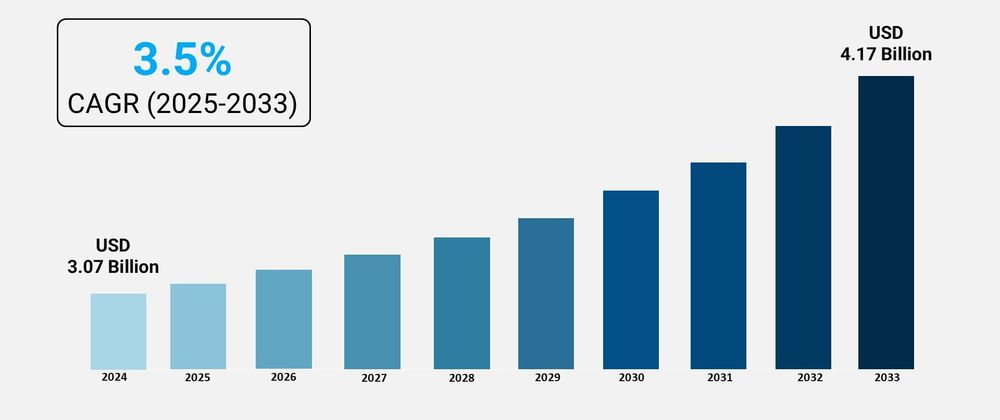
The automotive camshaft market is experiencing rapid growth, driven by sustained global vehicle production, stringent global emission and fuel economy regulations, and expansion of the global automotive aftermarket. According to IMARC Group's latest research publication, "Automotive Camshaft Market Report by Manufacturing Technology, Vehicle Type, Distribution Channel, and Region, 2025-2033", The global automotive camshaft market size was valued at USD 3.07 Billion in 2024. Looking forward, IMARC Group estimates the market to reach USD 4.17 Billion by 2033, exhibiting a (CAGR) of 3.5% during 2025-2033.
This detailed analysis primarily encompasses industry size, business trends, market share, key growth factors, and regional forecasts. The report offers a comprehensive overview and integrates research findings, market assessments, and data from different sources. It also includes pivotal market dynamics like drivers and challenges, while also highlighting growth opportunities, financial insights, technological improvements, emerging trends, and innovations. Besides this, the report provides regional market evaluation, along with a competitive landscape analysis.
Download a sample PDF of this report: https://www.imarcgroup.com/automotive-camshaft-market/requestsample
Our report includes:
- Market Dynamics
- Market Trends and Market Outlook
- Competitive Analysis
- Industry Segmentation
- Strategic Recommendations
Growth Factors in the Automotive Camshaft Market
- Stringent Global Emission Standards and Engine Downsizing
The primary catalyst for the automotive camshaft market is the enforcement of rigorous environmental regulations such as Euro 6 and Bharat Stage VI. These mandates compel automotive manufacturers to adopt engine downsizing, where smaller, turbocharged engines replace larger ones to reduce carbon footprints without sacrificing power. In 2023, global passenger car production reached approximately 68 million units, many of which utilized advanced camshaft designs to optimize valve timing and combustion efficiency. The necessity for precision-engineered components has led to increased investments from companies like thyssenkrupp AG, which recently expanded its production of adjustable camshafts in Hungary, Mexico, and China. Furthermore, the International Energy Agency reports that gasoline-powered vehicles still accounted for nearly 60% of global vehicle sales in 2023, ensuring a robust demand for high-performance camshafts that help meet localized emission targets through better fuel management.
- Rising Demand for Hybrid Powertrain Solutions
The transition toward sustainable mobility has created a significant bridge market for hybrid electric vehicles (HEVs), which still rely on internal combustion engines and, consequently, camshafts. In January 2025, sales of hybrid electric vehicles and plug-in hybrids in the United States alone reached 131,052 units, a substantial 42.6% increase compared to the previous year. These vehicles require specialized camshafts, such as those integrated into the dual-mode systems used by Toyota and Hyundai, to manage the seamless transition between electric and gasoline power. Hyundai Motor Group’s 2025 introduction of its next-generation hybrid system highlights this trend, utilizing advanced engineering to improve fuel efficiency through precise valve control. This hybridization trend sustains the camshaft market by requiring components that are both lightweight and capable of handling the unique thermal stresses associated with frequent engine start-stop cycles in hybrid configurations.
- Expansion of the Automotive Aftermarket and Customization
A flourishing global aftermarket, particularly in emerging economies like India and Brazil, provides a resilient revenue stream for camshaft manufacturers. As the average age of the global vehicle fleet increases, the demand for replacement parts and engine overhauls rises. For instance, Dorman Products recently launched over 300 new motor vehicle parts, including camshaft phaser repair bolts, to cater to the repair needs of millions of older vehicles. Beyond simple maintenance, there is a growing consumer trend toward vehicle customization and performance tuning. In early 2025, Elgin Industries introduced five new Pro-Stock camshaft kits specifically designed to enhance street and racing performance for GM engines. This segment is further supported by the proliferation of e-commerce platforms like eBay and Amazon, which have made high-quality, precision-engineered camshafts more accessible to DIY enthusiasts and independent repair shops across the Asia-Pacific and North American regions.
Key Trends in the Automotive Camshaft Market
- Adoption of Lightweight Assembled Camshafts
A major shift is occurring from traditional solid cast iron camshafts to lightweight assembled designs. Assembled camshafts are constructed by joining individual lobes onto a hollow steel tube, which can reduce the total component weight by as much as 30% to 45% compared to conventional solid versions. This weight reduction is critical for manufacturers striving to improve overall vehicle fuel economy and reduce inertia within the valvetrain. Companies are increasingly moving toward this technology to allow for the use of different materials for the lobes and the shaft, optimizing for both durability and lightness. The demand for these components is particularly high in the passenger car segment, where every gram of weight saved contributes to meeting corporate average fuel economy standards. This trend is also driving innovation in joining techniques, such as thermal expansion or laser welding, to ensure structural integrity.
- Integration of Advanced Variable Valve Timing (VVT) Systems
The integration of sophisticated Variable Valve Timing (VVT) and Variable Valve Lift (VVL) technologies has become a standard requirement in modern engine design. Unlike traditional fixed camshafts, VVT-enabled camshafts allow the engine to adjust the timing of the valve opening and closing based on the engine's speed and load. This adaptability significantly improves volumetric efficiency and reduces nitrogen oxide emissions. In 2024, the inline engine segment, which heavily utilizes VVT technology for small and compact vehicles, held a dominant 77% revenue share in the Asian market. Real-world applications of this trend are seen in the widespread adoption of "Cam-in-Cam" designs and hydraulic phasers, which provide a broader range of timing adjustment. These systems are now being paired with advanced sensors, such as the new camshaft position sensors launched by DRiV™ in 2024, to provide real-time data for precise engine management.
- Implementation of Additive Manufacturing for Specialized Components
The automotive industry is increasingly leveraging 3D printing and additive manufacturing to produce complex camshaft geometries that were previously impossible or too expensive to create via traditional casting or forging. This trend is particularly prevalent in the production of low-volume, high-performance engines and prototype development for hybrid systems. Additive manufacturing allows engineers to create internal cooling channels or complex lobe profiles that enhance engine responsiveness and longevity. For example, racing and luxury vehicle segments are utilizing these technologies to produce custom-profile camshafts that can withstand extreme thermal and mechanical stress. According to industry insights, the automotive sector now accounts for roughly one-eighth of total global revenue generated by additive manufacturing. This shift enables faster iteration cycles for manufacturers, allowing them to bring more efficient engine designs to market in a fraction of the time required by traditional tooling processes.
Leading Companies Operating in the Global Automotive Camshaft Industry:
- Mahle GmbH
- JD Norman Industries, Inc.
- Thyssenkrupp AG
- Linamar Corporation
- Estas Camshaft & Chilled Cast
- Crance Cams Inc.
- Aichi Forge USA Inc.
- Engine Power Components Inc.
- Hirschvogel Holding GmbH
- Kautex Textron Gmbh & Co. KG
- Shadbolt Cams
- Comp Performance Group
- Precision Camshafts Ltd.
- Varroc Group
- Camshaft Machine Company
Automotive Camshaft Market Report Segmentation:
By Manufacturing Technology:
- Cast Camshaft
- Forged Steel Camshaft
- Assembled Camshaft
Forged steel camshafts lead the market in 2024 due to their strength, longevity, and performance in extreme conditions, making them the preferred choice for high-performance and fuel-efficient vehicles.
By Vehicle Type:
- Passenger Car
- Light Commercial Vehicle
- Heavy Commercial Vehicle
Passenger cars dominate the market with around 65.3% share in 2024, driven by growing production, demand for advanced camshaft technologies, and the rise of electric and hybrid vehicles.
By Distribution Channel:
- OEM
- Aftermarket
OEMs lead the market with around 60.0% share in 2024, as they manufacture camshafts for new vehicles and drive advances in technology to meet fuel efficiency and emissions regulations.
Regional Insights:
- North America (United States, Canada)
- Asia Pacific (China, Japan, India, South Korea, Australia, Indonesia, Others)
- Europe (Germany, France, United Kingdom, Italy, Spain, Russia, Others)
- Latin America (Brazil, Mexico, Others)
- Middle East and Africa
North America accounts for the largest market share of over 34.2% in 2024, supported by a strong automotive industry presence, technological advancements, and demand for high-performance and low-emission vehicles.
Note: If you require specific details, data, or insights that are not currently included in the scope of this report, we are happy to accommodate your request. As part of our customization service, we will gather and provide the additional information you need, tailored to your specific requirements. Please let us know your exact needs, and we will ensure the report is updated accordingly to meet your expectations.
About Us:
IMARC Group is a global management consulting firm that helps the world’s most ambitious changemakers to create a lasting impact. The company provide a comprehensive suite of market entry and expansion services. IMARC offerings include thorough market assessment, feasibility studies, company incorporation assistance, factory setup support, regulatory approvals and licensing navigation, branding, marketing and sales strategies, competitive landscape and benchmarking analyses, pricing and cost research, and procurement research.
Contact Us:
IMARC Group
134 N 4th St. Brooklyn, NY 11249, USA
Email: [email protected]
Tel No:(D) +91 120 433 0800
United States: +1-201971-6302




Top comments (0)