

Market Overview:
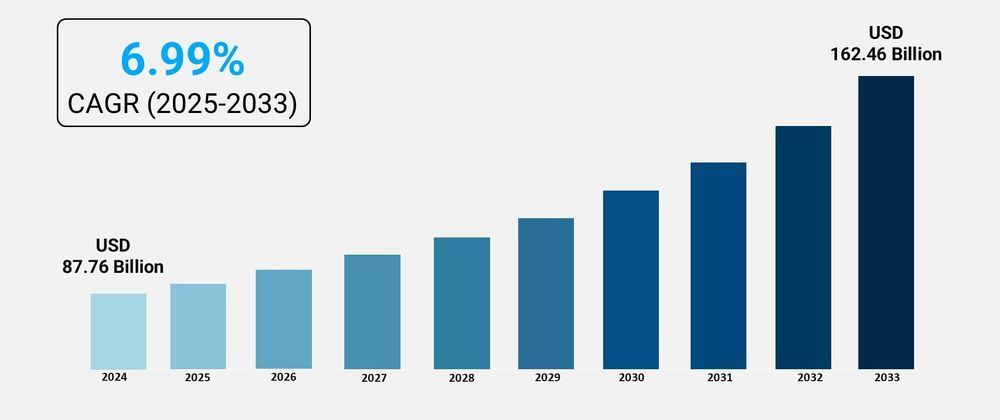
The home automation system market is experiencing rapid growth, driven by the convergence of IoT and smartphone ecosystems, growing focus on energy efficiency and sustainability, and increased demand for home security and remote monitoring. According to IMARC Group's latest research publication, "Home Automation System Market Size, Share, Trends and Forecast by Application, Type, and Region, 2025-2033", The global home automation system market size was valued at USD 87.76 Billion in 2024. Looking forward, IMARC Group estimates the market to reach USD 162.46 Billion by 2033, exhibiting a CAGR of 6.99% during 2025-2033.
This detailed analysis primarily encompasses industry size, business trends, market share, key growth factors, and regional forecasts. The report offers a comprehensive overview and integrates research findings, market assessments, and data from different sources. It also includes pivotal market dynamics like drivers and challenges, while also highlighting growth opportunities, financial insights, technological improvements, emerging trends, and innovations. Besides this, the report provides regional market evaluation, along with a competitive landscape analysis.
Download a sample PDF of this report: https://www.imarcgroup.com/home-automation-system-market/requestsample
Our report includes:
- Market Dynamics
- Market Trends and Market Outlook
- Competitive Analysis
- Industry Segmentation
- Strategic Recommendations
Growth Factors in the Home Automation System Market
- The Convergence of IoT and Smartphone Ecosystems
The widespread adoption of Internet of Things (IoT) devices and the high global penetration of smartphones serve as a primary catalyst for industry expansion. These technologies are foundational, enabling seamless control and monitoring of a home's entire system from a single, accessible mobile application. For instance, the hardware segment, which includes sensors, controllers, and hubs, generated a substantial portion of the overall market revenue in a recent year, demonstrating the massive installed base of connected components. Leading technology firms are constantly releasing new versions of voice assistants and compatible devices, fostering a strong ecosystem where consumers can easily integrate new products. This convenience and flexibility, driven by an interconnected device landscape, are transforming how homeowners interact with their living spaces and significantly boosting product adoption across all regions.
- Growing Focus on Energy Efficiency and Sustainability
The increasing consumer demand for solutions that reduce utility costs and support environmental responsibility is a major driver, making energy management systems (EMS) a high-growth segment. Smart home systems offer optimized control over HVAC, lighting, and appliances, leading to significant reductions in residential energy consumption. For example, government policies in various countries, such as incentives for green energy adoption or smart city initiatives, are creating a supportive framework for this technology. Companies like Schneider Electric and other energy management leaders continually launch cutting-edge home energy solutions, including smart panels and power strips, specifically designed to monitor and manage energy usage in real-time. This regulatory push combined with cost-saving appeal is propelling the widespread adoption of smart thermostats and automated lighting controls globally.
- Increased Demand for Home Security and Remote Monitoring
Elevated consumer concerns regarding safety and the desire for constant property oversight are fueling rapid growth in the security and access control segment of the market. This includes smart locks, surveillance cameras, and video doorbells, which provide homeowners with real-time alerts and remote control capabilities via mobile devices. One recent analysis indicated that the security and safety application segment accounts for a dominant share of the home automation market's revenue, underscoring its importance. Major players are strategically focusing on innovation in this area, incorporating advanced features like AI-driven facial recognition and motion detection into their security offerings. The ability to monitor property from any location provides significant peace of mind and drives substantial investment in integrated, intelligent security setups for both new installations and existing home retrofits.
Key Trends in the Home Automation System Market
- Integration of Artificial Intelligence for Proactive Automation
The market is shifting towards systems that use Artificial Intelligence (AI) and Machine Learning (ML) to enable proactive, personalized automation rather than simple remote control. AI algorithms are now collecting data on a household's behavioral patterns—such as preferred temperature at different times of day or daily lighting schedules—to make autonomous adjustments. For example, advanced smart thermostats learn a family's habits to automatically pre-heat or cool a home to the perfect temperature, even accounting for external factors like weather forecasts. Furthermore, innovative home robots and smart appliances, such as those demonstrated by Samsung Electronics, are being introduced with sophisticated, multi-functional capabilities to learn and improve daily life through constant interaction, moving the system from a tool to a truly intuitive assistant.
- The Rise of Interoperability Standards and Unified Ecosystems
A critical emerging trend is the movement toward open and unified connectivity standards, which address the long-standing challenge of incompatible devices from different manufacturers. Initiatives like Matter and Thread are gaining traction, allowing a smart speaker from one brand to seamlessly control a light bulb from another, dramatically simplifying the consumer experience. This focus on enhanced interoperability is a direct response to consumer frustration with fragmented ecosystems. For example, major technology giants are now collaborating to ensure their smart home products are mutually compatible out of the box. This trend will simplify device setup, reduce system complexity, and ultimately encourage consumers to invest in a broader range of products, knowing that all components will work together smoothly.
- Smart Living Solutions for the Aging-in-Place Demographic
As populations age across developed economies, there is a distinct and growing trend toward using home automation systems to support "aging-in-place," enabling seniors to live independently and safely for longer. This includes specialized applications like fall detection sensors, smart medication dispensers, and remotely monitored health devices. For instance, sensors can track movement patterns to detect anomalies, alerting caregivers or emergency services to potential issues. Companies are developing smart solutions that monitor vital signs and automatically adjust living conditions like lighting and climate for optimal comfort and safety. This application of home automation addresses a profound societal need, transforming the technology from a luxury into an essential service that enhances safety, independence, and overall quality of life for the elderly.
Leading Companies Operating in the Global Home Automation System Industry:
- Siemens AG
- Honeywell International, Inc.
- Johnson Controls, Inc.
- Schneider Electric SE
- Legrand SA
- Ingersoll-Rand PLC
- ABB Ltd.
- Acuity Brands, Inc.
- Samsung Electronics Co., Ltd.
Home Automation System Market Report Segmentation:
By Application:
- Lighting Control
- Security and Access Control
- HVAC Control
- Entertainment and Other Controls
Entertainment and other controls lead the market in 2024 due to high consumer demand for convenience, customization, and better living experiences.
By Type:
- Luxury (Custom)
- Mainstream
- DIY (Do-It-Yourself)
- Managed
Managed dominates the market with around 35.0% market share due to growing consumer preference for professionally installed and maintained smart home solutions.
Regional Insights:
- North America (United States, Canada)
- Europe (Germany, France, United Kingdom, Italy, Spain, Russia, Others)
- Asia (China, Japan, India, South Korea, Australia, Indonesia, Others)
- Rest of the World
Asia enjoys the leading position with over 30.9% market share owing to rapid urbanization, high internet-connected device penetration, and significant investments in smart home infrastructure, particularly in China, Japan, and South Korea.
Note: If you require specific details, data, or insights that are not currently included in the scope of this report, we are happy to accommodate your request. As part of our customization service, we will gather and provide the additional information you need, tailored to your specific requirements. Please let us know your exact needs, and we will ensure the report is updated accordingly to meet your expectations.
About Us:
IMARC Group is a global management consulting firm that helps the world’s most ambitious changemakers to create a lasting impact. The company provide a comprehensive suite of market entry and expansion services. IMARC offerings include thorough market assessment, feasibility studies, company incorporation assistance, factory setup support, regulatory approvals and licensing navigation, branding, marketing and sales strategies, competitive landscape and benchmarking analyses, pricing and cost research, and procurement research.
Contact Us:
IMARC Group
134 N 4th St. Brooklyn, NY 11249, USA
Email: [email protected]
Tel No:(D) +91 120 433 0800
United States: +1-201971-6302




Top comments (0)